
Radon in Chicago and the Surrounding Suburbs: Why Ground-Contact Units Matter Most
Radon in Chicago is easy to underestimate because the region feels so built-up and vertical—courtyard buildings, multi-flats, condos, and tight lot lines. But radon doesn’t care what’s happening at street level. It starts below the building, then follows the paths that connect soil to indoor air.
That’s what makes the Chicago metro’s housing mix especially relevant. We don’t just have “homes”—we have a huge number of ground-contact living spaces: finished basements used as family rooms or home offices, garden units that function as full apartments, and split-level lower floors that sit partly below grade. In a high-density area, the same address can include units with very different radon exposure simply because some spaces touch the ground and others don’t.
The big takeaway is simple: if your living space touches the ground—garden unit, basement, lower level, slab-on-grade first floor—it deserves priority testing, whether you’re in the city or in suburbs like Oak Park, Cicero, Evanston, Skokie, Berwyn, Naperville, Schaumburg, or Downers Grove.
Why radon affects both Chicago and nearby suburbs
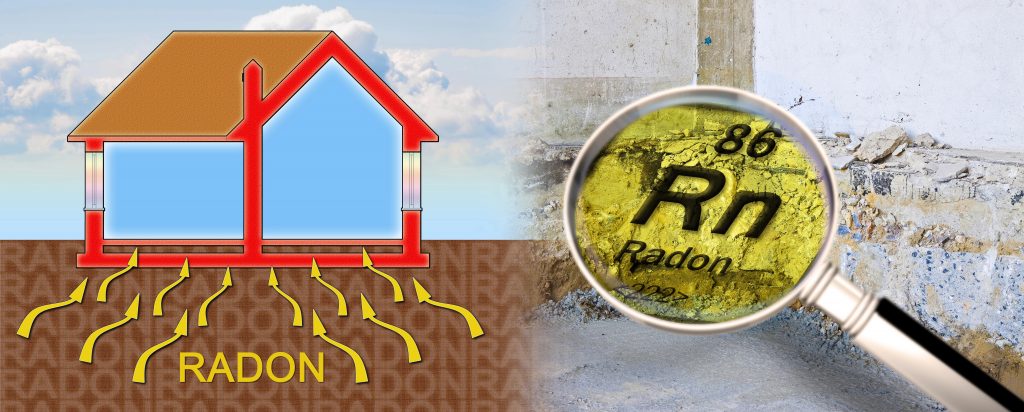
Radon comes from the ground and can build up indoors, especially in lower levels. In the Chicago area, that means the risk story isn’t “city vs. suburb”—it’s ground-contact vs. not.
It’s about geology and soil gas—not “city vs. country”
Across Chicago and the surrounding communities, radon potential comes down to what’s under the structure and how the building interacts with the ground. Practical factors that influence whether radon moves inside include:
- Soil and rock conditions (and how soil gas moves)
- Moisture and drainage patterns around the foundation
- Foundation type and ordinary gaps/openings
- Pressure differences that pull soil gas inward (stack effect, HVAC, exhaust fans)
That’s why variability can be house-to-house and block-to-block. Two similar-looking homes in Berwyn might test differently. Two units in the same courtyard building in Evanston can test differently too—especially if one is a garden unit and one is on an upper floor.
Radon Levels in the Greater Chicago Area and Surrounding Communities
Variability is the headline
When people search “radon in suburbs near Chicago” or “Cook County radon,” they usually want a quick answer. What you get in reality is a local picture: trends can help with awareness, but your result depends heavily on the specific unit and whether it’s in contact with the ground.
That’s especially true for garden units and basements in dense neighborhoods—where one building can contain both the highest-priority spaces (ground-contact) and the lowest-priority spaces (upper floors). This holds across Chicago and nearby communities like Oak Park, Cicero, Evanston, Skokie, and Berwyn, and it also applies in farther suburbs like Schaumburg, Downers Grove, and Naperville.
If you want to explore community-level context, start with a local directory and statewide overview:
| City | Submissions | Avg pCi/L | Median pCi/L | % ≥ 4.0 | Max |
|---|---|---|---|---|---|
| Arlington Heights, IL | 5 | 5.6 | 5.0 | 80% | 8 |
| Aurora, IL | 4 | 6.8 | 7.0 | 100% | 8 |
| Naperville, IL | 4 | 6.2 | 5.0 | 100% | 11 |
| Chicago, IL | 3 | 11.0 | 11.0 | 67% | 20 |
| Tinley Park, IL | 3 | 7.7 | 8.0 | 100% | 8 |
| Joliet, IL | 3 | 6.7 | 7.0 | 100% | 8 |
| Schaumburg, IL | 3 | 4.3 | 4.0 | 100% | 5 |
How to interpret aggregated or user-submitted data (and its limits)
Aggregated “testing databases” or user-submitted maps can be useful for spotting patterns, but they’re easy to misread if you don’t account for unit type and building layout:
- Sampling bias: People often test because they suspect an issue (or during a sale), not randomly.
- Unit type matters: A third-floor condo result doesn’t represent a garden unit in the same building.
- Season matters: Winter “closed-house” conditions can produce higher readings than mild-weather testing.
- Mitigation history: Some homes are already mitigated; results may reflect post-mitigation conditions.
- Measurement type: Short-term vs long-term tests can tell different stories.
Use community trends as a prompt—not a conclusion. For neighborhood-level browsing and comparisons, see:
Foundation styles common across the metro
Chicago-area buildings span multiple eras and construction styles, and each one creates its own set of “normal” pathways where soil gas can move. You don’t need to diagnose your foundation like an engineer—but understanding the basics helps you test in the right spot and interpret results without overthinking them.
Vintage Chicago housing (city + inner-ring suburbs)
Common building types across Chicago, Cicero, Berwyn, Oak Park, and parts of Evanston/Skokie include:
- Bungalows (often with basements that get finished over time)
- 2-flats and 3-flats (basement laundry/mechanical spaces; sometimes garden units)
- Courtyard buildings (more ground-contact units; shared utility runs)
- Older brick and masonry foundations (more joints, patches, and penetrations)
In these buildings, basements aren’t just “utility space.” They’re where people put a second TV room, a workout area, a guest bedroom, or a desk when the main floors are tight. Garden units, meanwhile, are a common way renters and owners add livable square footage—exactly why ground-contact testing matters.
Suburban single-family mix
In places like Naperville, Schaumburg, and Downers Grove you’ll see:
- Brick Georgian colonials (often full basements)
- Split-levels and raised ranches (lower levels partly below grade)
- Ranches (basement or slab-on-grade depending on era)
- Newer slab-on-grade homes (radon can still enter through slabs and penetrations)
Even when a home feels “newer” or more open-plan, radon pathways don’t disappear—they just change shape. Slabs, utility penetrations, and sump areas still connect indoor air to the ground.
Common radon entry points (what to look for)
Radon typically enters where the building meets the ground, including:
- Sump pits (especially uncovered or loosely covered)
- Floor cracks and wall-floor joints (cove joints)
- Utility penetrations (gas line, water line, electrical)
- Drain tiles and perimeter drainage systems
- Crawlspaces (vents and soil exposure)
- Slab joints and control cuts
- Around floor drains, ejector pits, and cleanouts
You don’t need to “find the crack” to justify testing. Many of these are ordinary features in Chicago-area foundations—especially in older properties throughout Skokie, Oak Park, and Berwyn, and in basement-heavy subdivisions in Downers Grove and Naperville.
Garden units, basements, and split-level homes
If you remember one section, make it this one: ground-contact units are the highest priority for radon testing because they sit closest to the source and usually have the most direct entry routes.
In the Chicago metro, “ground-contact” isn’t a niche scenario—it’s a normal part of how people live. A garden unit can be someone’s primary apartment. A basement can be a teen hangout, an in-law setup, a guest room, or a work-from-home space. Those are exactly the rooms where you want clarity.
Garden unit radon (Chicago classic)
Garden units are common across Chicago and inner suburbs like Evanston, Oak Park, Cicero, and Berwyn. They often have:
- Below-grade walls
- Shared mechanical spaces nearby
- Sump pits and drain tiles in older buildings
- Limited ventilation compared to upper floors
If you rent a garden unit, it’s reasonable to ask the owner or property manager about prior Radon Testing—and to request testing if it hasn’t been done. If you own a building with a garden level, prioritizing that unit protects the people most likely to have higher exposure.
Basements: finished or unfinished, it still matters
A finished basement family room, home office, or bedroom is a living space—so it should be tested like any other. And even if the basement is unfinished, it can still influence air upstairs through stairwells, ductwork, and ordinary air movement.
Basements worth prioritizing include those with:
- Sumps or ejector pits
- Recent “tightening” upgrades (new windows, insulation, air sealing)
- Persistent dampness (not proof of radon, but commonly overlaps with soil-gas movement)
This comes up constantly in older homes from the city to Skokie, where basements were originally utility-forward and later converted into comfortable daily-use spaces without anyone revisiting indoor air questions.
Split-level and raised ranch homes (suburb favorite)
Split-levels in places like Downers Grove, Schaumburg, and Naperville often have a lower level that’s partly below grade. People sometimes assume “it’s not a basement,” so radon won’t apply. In practice, that lower level can behave like a basement because it shares walls or a floor with soil.
Rule of thumb: If the floor is on or below grade—or the room shares walls with soil—test it.
Testing guidance for dense housing areas
Dense housing changes the logistics. It doesn’t change the principle: test the spaces that touch the ground first, because that’s where radon entry is most likely and where elevated results matter most for day-to-day exposure.
Where to place a test (and why placement matters)
In multi-unit buildings and compact neighborhoods, placement is the difference between a useful result and a confusing one.
Test the lowest lived-in level:
- Garden unit living area/bedroom
- Basement family room or basement bedroom
- Split-level lower family room
- First-floor slab-on-grade spaces
Avoid placing a test:
- In kitchens, bathrooms, or laundry rooms (humidity and airflow swings)
- Right next to exterior doors/windows
- Directly in front of supply vents or fans
- In a crawlspace (unless it’s actually used as living space—rare)
If you’re in a Chicago courtyard building—or managing units in Evanston or Oak Park—don’t let convenience push the test into a hallway or utility area that nobody actually lives in. You want the result to represent real exposure in the unit.
Short-term vs long-term: what to choose
- Short-term tests (2–7 days): Useful for quick screening or real estate timelines.
- Long-term tests (90+ days): Better picture of typical exposure over time.
Chicago winters often create “closed-house” conditions naturally, which can be helpful for screening because buildings are sealed up. But any season can work—what matters most is following the test instructions and selecting the right level.
Multi-unit buildings: test smart
For condo associations/HOAs and landlords, the most practical approach is usually:
- Start with ground-contact units
- Include units next to mechanical rooms or sump locations
- Consider testing a sample of upper units for comparison, especially if there are open chases
If you manage multiple buildings in Cicero and Berwyn, or you oversee properties spread from Chicago out to Skokie, standardizing your Radon Testing protocol helps you make consistent decisions building-to-building—especially when garden units and finished basements are part of the rental inventory.
Real estate considerations
This is educational information, not legal advice—but these are common, practical realities in Chicago-area transactions, where basements and garden units regularly show up as “bonus space” during tours.
Buyers: build testing into your inspection plan
If you’re buying a bungalow in Chicago, a Georgian in Oak Park, or a split-level in Naperville, radon testing is a straightforward add-on during the inspection window—especially when the space you’ll actually use most is on the lowest level.
Tips:
- Ask for a radon test on the lowest lived-in level
- If there’s a garden unit (legal or “in-law”), test that space specifically
- If the home has a mitigation system already, ask for documentation and consider a follow-up test to confirm performance
Sellers: testing early reduces surprises
A pre-listing test can prevent last-minute negotiations—particularly in homes where the basement is staged as a TV room, guest suite, or office (common across the city and suburbs like Downers Grove and Schaumburg).
Condo buyers and HOAs
Condo situations vary widely:
- A 3rd-floor unit may have low risk, while the garden unit below may not.
- Mitigation may involve shared spaces, piping routes, or HOA approval.
If you’re buying a ground-contact condo in Evanston or Skokie, ask:
- Has the building tested ground-contact units?
- Any history of mitigation systems?
- Who is responsible for mitigation if needed (unit owner vs association)?
Renters: how to approach the conversation
If you rent a garden unit in Chicago or Berwyn, you can politely request:
- Prior radon testing results (if any)
- Permission for testing (many landlords will agree)
- A plan to address elevated results if found
Keeping the request tied to the unit’s ground-contact nature (rather than general fear) usually makes the conversation more straightforward: you’re asking to test the space with the most direct connection to the soil, not making assumptions about the whole building.
Mitigation expectations
If testing shows elevated radon, mitigation is usually very doable—especially in the types of basements and slab foundations common across Chicago and nearby suburbs. The practical goal is to address the ground-contact pathway, not to chase every tiny crack.
The most common approach: sub-slab depressurization
A standard system often includes:
- A pipe routed from under the slab to above the roofline
- A quiet, continuous fan that creates suction under the foundation
- Sealing of obvious openings as support, not the primary fix
- Attention to sump pit covers (tight-fitting, sealed lids are common)
For more detail on methods and system components, see:
How long it takes
In many single-family homes, installation is often completed in one day, though scheduling, electrical work, and routing complexity can add time.
Costs vary—avoid assumptions
Pricing depends on:
- Foundation style (full basement vs slab vs crawlspace)
- Sump/drain tile layout
- Pipe routing in finished spaces
- Electrical access and exterior placement
- Multi-unit complexity
That variability shows up everywhere—from older brick homes in Oak Park to split-levels in Schaumburg—so it’s more useful to compare proposed approaches than to chase a single “average.”
Multi-unit buildings need coordination
For condos and apartment buildings in Chicago, Evanston, or Cicero, mitigation can involve:
- Shared piping chases or utility shafts
- Coordinating access to multiple units
- HOA approvals and building rules
- Testing multiple ground-contact units before and after mitigation
A building-wide plan (test → prioritize ground-contact units → mitigate where needed → confirm with follow-up tests) tends to work best, especially where garden units are lived in year-round.
Brief safety note
If results come back high, follow EPA and Illinois guidance and work with a qualified radon professional to confirm levels and choose the right fix.
FAQ: Ground-contact units, condos, and rentals
Does a first-floor unit need testing if there’s a basement below?
If the basement is below and not living space, the first floor can still be affected—especially if there are open stairwells, utility chases, or air movement from below. Testing the lowest lived-in level is still the priority, and additional testing can be added if needed.
I’m on the 2nd or 3rd floor—can I skip it?
Upper floors often test lower, but “often” isn’t “always.” If there’s a known radon issue in the building, testing your unit can still be reasonable. Ground-contact units remain the first priority.
Can I test in a rental garden unit?
Usually yes, with landlord permission. Many property managers appreciate a clear, documented result. Ask where they prefer placement so the test isn’t disturbed.
If my neighbor tested low, am I in the clear?
Not necessarily. Differences in cracks, sumps, ventilation, and unit layout can change results even next door or downstairs.
Do I need a professional test?
DIY tests can be a good starting point when used correctly. For real estate transactions or when confirming elevated results, professional measurement is common.
Clear next steps checklist
- Identify ground-contact spaces: garden unit, basement rooms, split-level lower level, slab-on-grade first floor—especially the rooms you actually live in (sleep, work, relax).
- Prioritize the highest-risk locations first: in Chicago and close-in suburbs like Oak Park, Cicero, Evanston, Skokie, and Berwyn, that often means garden units and finished basements; in Naperville, Schaumburg, and Downers Grove, it’s often basements and split-level lower floors.
- Choose the right test type: short-term for quick screening; long-term for a better year-round picture.
- Place the test correctly: lowest lived-in level, away from drafts, windows, kitchens, baths, and vents.
- Follow closed-house instructions (as required) and don’t disturb the device.
- Record details: start/end times, weather notes, HVAC use, and which room/level was tested.
- Review results using EPA/Illinois guidance and don’t over-interpret neighborhood averages—especially when comparing upper floors to ground-contact units.
- If elevated, plan next steps: confirm with follow-up testing if appropriate and contact a qualified mitigator.
- For multi-unit buildings: coordinate with your HOA/landlord to test multiple ground-contact units first, then document outcomes for the building.
- Use local resources to compare context and plan testing across the metro: Chicago, IL and User Submitted Radon Levels.
Radon in Chicago and across the metro isn’t a “city vs suburb” issue—it’s a ground-contact issue. If the space touches the ground, treat it as the priority and test it accordingly.