We Tested and Ranked the 7 Best Radon Test Kits on Amazon (2026 Update)
Radon testing doesn’t have to be complicated — but choosing the right kit can be.
Walk into the topic cold and you’ll quickly find yourself staring at a confusing mix of charcoal canisters, alpha track detectors, and digital monitors ranging from $15 to $239. They’re not interchangeable, and picking the wrong one for your situation means either wasted money or, worse, results you can’t act on.
We’ve spent time breaking down every major option available on Amazon right now — short-term kits, long-term alpha track kits, and continuous digital monitors — and put together a full comparison guide so you don’t have to do the homework yourself.
Here’s the short version:
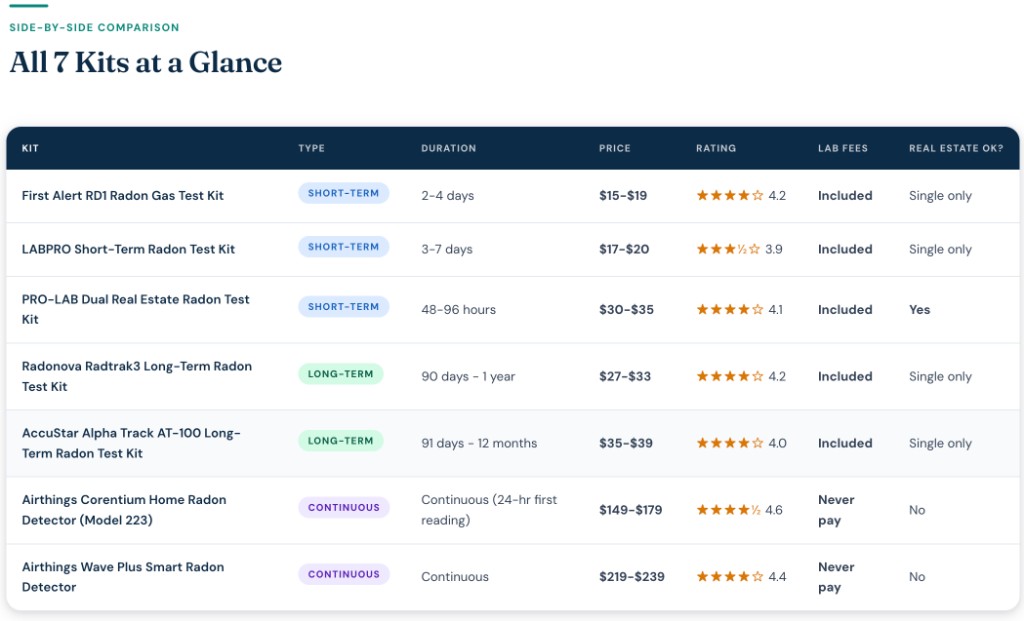
If you’ve never tested your home before, the First Alert RD1 ($15–$19) is the easiest starting point. Lab fees are included, results come back in 3–5 days, and it’s listed under the EPA’s Radon Gas Measurement Proficiency Program.
If you’re buying or selling a home, skip the single-detector kits entirely. The PRO-LAB Dual Real Estate Kit ($30–$35) includes two canisters — which is what inspectors and the EPA actually recommend for real estate transactions.
If you want the most accurate picture of your home’s true radon exposure over time, a long-term alpha track kit like the Radonova Radtrak³ ($27–$33) is the right call. It captures seasonal swings that a 3-day charcoal test simply cannot.
And if you’d rather skip lab fees and mail-in waits altogether, the Airthings Corentium Home ($149–$179) gives you continuous, real-time readings with over 10,000 Amazon reviews and a 4.6-star rating to back it up.
One thing worth knowing before you buy: digital monitors — no matter how accurate — are not accepted for real estate transactions. Only certified mail-in kits processed by an accredited lab meet that standard. It’s a detail that trips up a lot of buyers.
The full guide includes side-by-side specs, current Amazon prices, pros and cons for each kit, and a quick recommendation chart that matches your specific situation to the right product.
→ Read the Full Radon Test Kit Comparison Guide
If your home has never been tested, there’s no better time than now. The EPA estimates that 1 in 15 U.S. homes has elevated radon levels — and since radon is invisible, odorless, and tasteless, a test kit is the only way to know where you stand.