
Why Radon Levels Rise When You Heat Your Home
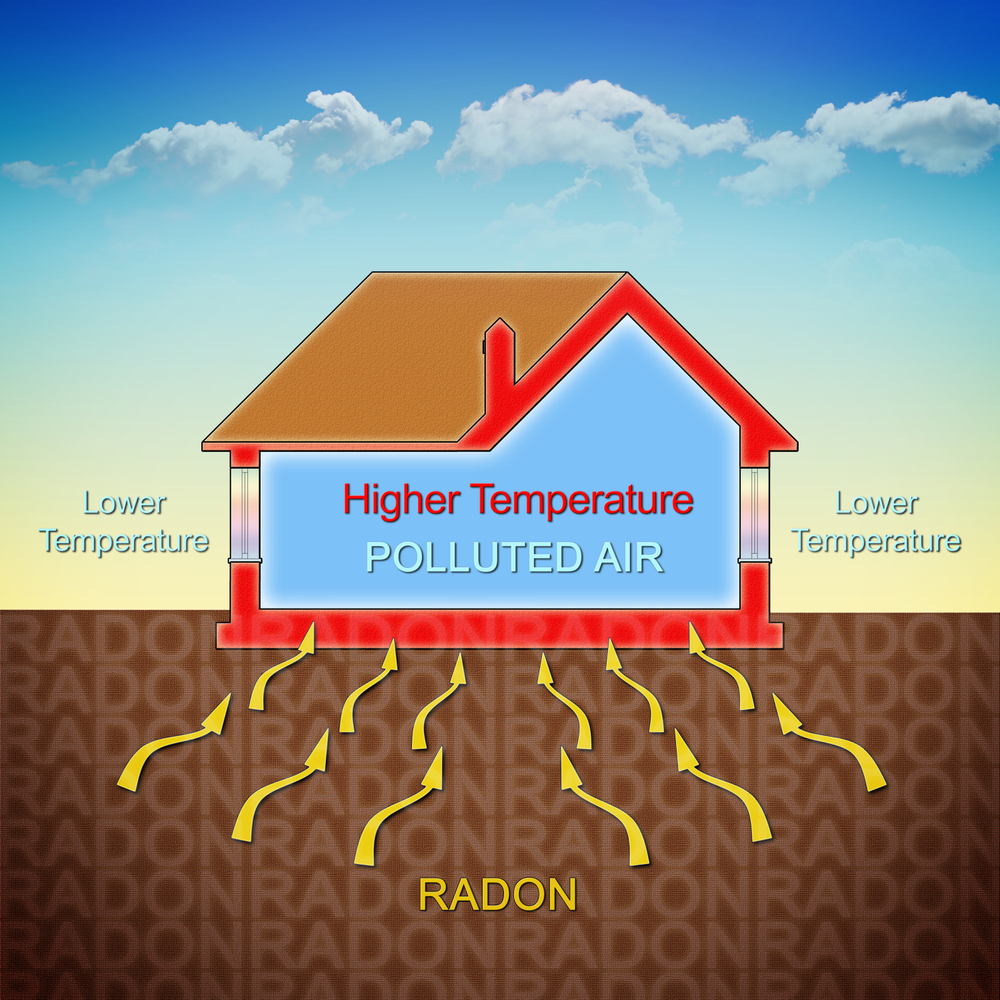
Why Radon Levels Rise When You Heat Your House
When you heat your home in cold weather, the warm air inside rises and escapes through the upper floors, and air is pulled in through the lowest level to replace it. Some of that replacement air is drawn straight out of the soil beneath the foundation, and soil is where radon comes from. This effect, combined with closed windows that let less fresh air dilute what gets in, is why indoor radon commonly runs higher during the heating season than at other times of year. It doesn’t mean your furnace creates radon — it changes the air pressure in ways that pull more of it indoors.
This article explains the mechanism behind that seasonal rise, why it isn’t only about the furnace, how much levels can actually swing, and what it means for when and how you test.
The stack effect: warm air out the top, soil gas in the bottom
Radon is a naturally occurring radioactive gas that seeps up from soil and rock. It has no color or smell, so the only way to know your level is to test. It’s measured in picocuries per liter (pCi/L), and the U.S. EPA identifies long-term radon exposure as the second-leading cause of lung cancer in the United States and the leading cause among people who have never smoked.
The reason heating matters comes down to air pressure. Warm air is lighter than cold air, so when you heat the house, that warm air rises and a portion of it leaks out through gaps around the upper floors, the attic, and the roofline. As it leaves, it has to be replaced. The house draws in “make-up” air lower down, through the basement, the slab, and openings near the foundation. Radon researchers and state health agencies call this the stack effect, because a heated house behaves a little like a chimney.
The result is that the lower level of the home sits at a slightly lower pressure than the soil around and beneath it. That small pressure difference acts like a gentle vacuum, and soil gas — carrying radon with it — is pulled in through cracks in the slab, control joints, sump openings, and gaps around pipes. The bigger the temperature difference between inside and outside, the stronger the effect, which is why the coldest stretches of winter tend to produce the highest readings.
Closed windows make a second, separate difference
The stack effect changes how much radon is pulled in. Closed-up windows change how much stays. In summer, open windows and doors let outdoor air move through and dilute whatever radon enters, so concentrations often stay lower. Once the house is sealed against the cold, that natural ventilation drops, and the radon that gets pulled in has fewer ways out. Less fresh air exchange means the gas can build to higher concentrations in the same house.
These two things work together during the heating season: more radon drawn in through the foundation, and less air movement to carry it back out. That combination is why EPA and many state programs point to winter, when homes are shut tight, as the period when indoor radon is most likely to accumulate.
It isn’t only the furnace
Heating is the most common driver of the stack effect, but anything that pushes air out of the house or lowers indoor pressure can pull more soil gas in. Bathroom and kitchen exhaust fans, clothes dryers, and range hoods all vent indoor air outdoors. Fireplaces and wood stoves send a steady stream of air up the chimney. Combustion appliances such as furnaces and water heaters that draw their air from inside the house add to the same effect.
None of these are reasons to stop using normal appliances, and none of them are the source of radon. They’re worth understanding because they explain why radon entry is dynamic rather than fixed. The pressure balance of a house shifts with the weather, the wind, and what’s running inside it, and radon entry shifts along with it.
How much can levels actually change?
Radon varies from home to home and hour to hour, so there’s no single multiplier that applies everywhere. In general, indoor radon tends to be higher in winter than in summer, and studies of seasonal variation have found meaningful differences between heating-season and warm-season measurements in many homes. But the pattern is a tendency, not a guarantee. Some homes show the opposite, and factors like a home’s construction, the soil beneath it, and even a rainy or snowy spell can move a reading up or down.
Two practical points follow from that variability. A low reading taken with the windows open in July does not confirm a home is fine year-round, and a single high reading in January is a strong reason to look closer but is best confirmed before you act on it. Because levels move, one short snapshot is a starting point rather than a final verdict.
What this means for testing your home
The seasonal pattern is the reason radon tests are meant to be run under “closed-house conditions” — windows and outside doors kept shut except for normal entry and exit. Closed-house conditions reproduce the situation in which radon is most likely to be elevated, so they give a more protective picture than a test run with the house open. Winter naturally meets these conditions, which is why many agencies suggest the heating season as a good time to test.
You have two general options. A short-term test, run for a few days under closed-house conditions, tells you quickly whether radon looks elevated right now. A long-term test, run for more than 90 days, spans different weather and gives a better estimate of your year-round average exposure, which is ultimately what matters for health. If a short-term winter test comes back at or above the action level, a common next step is either a second short-term test or a longer test to confirm before committing to a fix. Our guides to radon testing and radon test kit options walk through how to choose and run a test, and our guide to interpreting a radon result explains what the number means.
On the numbers themselves: EPA recommends fixing homes at or above 4 pCi/L and considering action between 2 and 4 pCi/L. No level of radon is considered completely risk-free, so a result below 2 pCi/L lowers the odds of a problem but isn’t a guarantee of zero risk. Because levels change with the seasons, retesting periodically — and after any major change to the house or its heating and ventilation — is reasonable.
Does the seasonal effect change how radon is fixed?
It affects testing more than mitigation. The most common fix for an elevated home is active soil depressurization, in which a fan and vent pipe draw soil gas from beneath the slab and send it outside before it can enter. Because that system reverses the pressure relationship at the foundation, it works across the seasons rather than only in warm weather. Sealing cracks and openings helps a system perform but is usually not a dependable fix on its own for significantly elevated radon. After any mitigation system is installed, a follow-up test confirms it brought the level down. If you’re weighing a fix, our radon mitigation guide explains how these systems work.
Frequently asked questions
Is radon always higher in winter?
Usually, but not always. The stack effect from heating and the reduced ventilation of a closed-up house both tend to push winter levels higher, and that’s the general pattern seen across many homes. Individual homes can differ because of their construction, soil, and local weather, so the only way to know your own home’s pattern is to test — ideally with a long-term test that averages across seasons.
If my furnace raises radon, should I run it less?
No. The furnace doesn’t produce radon, and heating your home safely is more important than trying to manage radon by staying cold. The stack effect is a normal property of heated buildings. The effective response to elevated radon is a mitigation system that removes soil gas at the source, not changing how you heat or ventilate day to day.
Can I just open windows in winter to lower radon?
Opening windows can temporarily dilute indoor radon, but it’s not a practical or reliable long-term fix, especially in cold weather, and levels return once the house is closed again. Increased ventilation is sometimes used as a short-term measure, but a home with a confirmed elevated level is better served by a dedicated mitigation system.
My summer test was low. Do I still need to worry?
A low warm-weather reading is reassuring but not conclusive, because radon commonly rises once the heating season starts and the house is sealed. If your only test was taken with the windows open, a follow-up test under closed-house conditions — or a long-term test — gives a fuller picture of your year-round exposure.
What this means for you
Heating your home doesn’t create radon, but it changes the air pressure in a way that draws more soil gas indoors, and a closed-up house holds onto what gets in. That’s why the same home can read higher in January than in July, and why radon tests are designed to run under closed-house conditions. The practical takeaway is to test your home — during the heating season, or over a longer period that spans it — rather than assuming a single reading tells the whole story. To see what others in your area have measured, you can check reported radon readings near you, and if you’d like help testing or evaluating a result, request a free quote to connect with a qualified radon professional.
Sources and further reading
U.S. Environmental Protection Agency, A Consumer’s Guide to Radon Reduction
U.S. Environmental Protection Agency, Radon (overview, health risk, and action levels)
Minnesota Department of Health, Radon in Homes (stack effect, negative pressure, and closed-house conditions)
U.S. EPA New England, Winter Is the Time to Test Your Home for Radon
National Cancer Institute, Radon and Cancer
This article is for general educational purposes and is not medical advice. Long-term radon exposure is associated with an increased risk of lung cancer, but individual risk depends on many factors, including the level and length of exposure and smoking history. Reducing elevated radon can lower future exposure; it cannot undo exposure already received. For guidance on your specific home, consult a certified radon professional, and for health questions, consult a qualified medical provider.